
I've been working in publishing and technology for decades. I've built websites, taught authors to vet vanity presses, and flagged overpriced PR scams more times than I can count. But this year, I got scammed. Not dramatically. Just quietly, professionally, and by people who knew exactly how to sound legitimate.
Here's how it happened and how you can avoid a scam like this—and though it's a challenge—try to get your own legitimate Wikipedia page.
How It Started
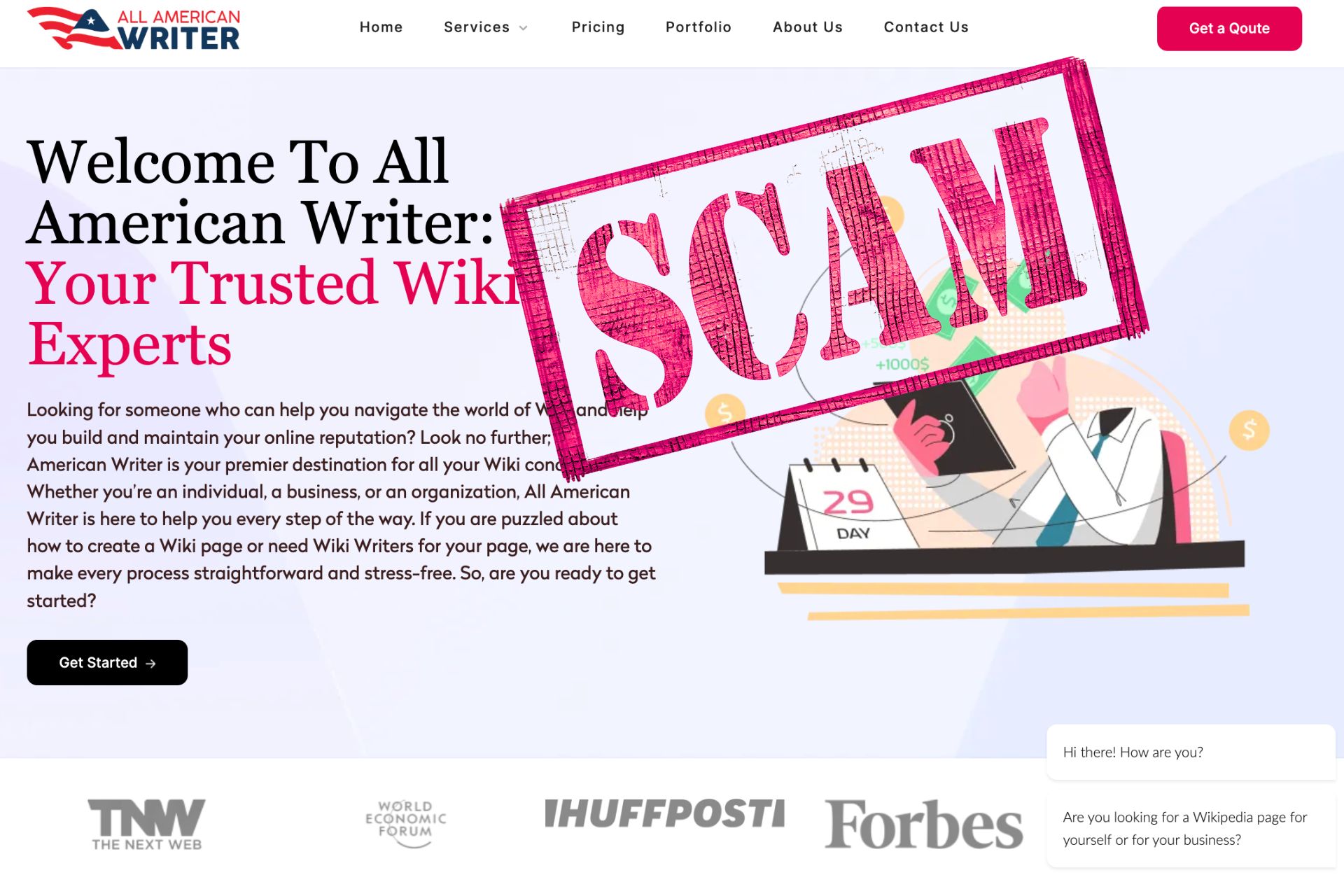
It began with an email offer: a $199 holiday discount on a professional Wikipedia page from a company called All American Writers. The company seemed credible and I was interested for myself and also for the authors I help in my business. So I thought I'd try it out, and looked forward to being able to recommend a service that authors wanted. (So. Very. Embarrassing.)
The emails came from "Senior Manager" Josh Wilson, and later I was handed off to a project coordinator named Owen Reeds. They had a slick website, a support team that replied quickly, and they spoke the language of Wikipedia insiders. They promised to research my background, prepare a proper notability report, and write and submit a Wikipedia article that would stick. I took the bait and paid $300—the discounted price on their $499 "Essential" package.
Not a huge risk, I thought. I was wrong, but I didn't know it yet.
Owen sent me an email and offered some soft upselling with a discount—which I always expect and don't resent from legit services—and we started to work.
The Sales Funnel Revealed
But then they started upselling relentlessly. I was irritated with them within just a few weeks after I hired them, with continual upsells rolling in: $250 to improve the article, $600 for additional press articles to boost "notability," $150 for "moderator coordination." They had a full sales funnel built around authors' hopes of being taken seriously by a platform that prides itself on editorial independence and verifiable sources.
They claimed: "We need at least 6 to 8 articles to make your profile sustainable forever... We can go ahead and create those articles for you which would be according to the guidelines, rules and regulations of Wikipedia."
This is where the scam really ramps up—offering to manufacture notability through fake or pay-to-play articles that don't meet Wikipedia's standards anyway.
Luckily, I stopped at the initial $300. I didn't buy the PR packages or credibility boosters. But I can see how someone could, especially if they've already sunk money and effort into the process. I stuck with it, and let Owen know I'd consider more services after they'd delivered on their promise.
When Suspicion Set In
Once I paid, the process moved quickly. Josh sent a questionnaire, and Owen followed up with a draft. I edited it, offered revisions, and they incorporated my changes.
Time went by and they kept emailing me with this and that and I had to make corrections to my info. There was always just a little typo or something off—though I'd given them good copy—and now I think they must have written me off as not susceptible to upselling, and was put on the back burner.
I persisted in insisting they deliver, and the language turned technical. They started talking about "Google indexing," and "verification period," before the page would be live on Wikipedia.org, and for me, this was a huge red flag.
I've worked in web development and SEO. I know that Google doesn't index a page on one domain and later transfer that indexing to another. Pages get indexed after they appear on their final destination, and that destination must be Wikipedia.org for a real Wikipedia article.
The Technical Confrontation
So I emailed Owen directly, letting him know what I knew, and insisting on a Wikipedia.org page:
"Google cannot index a page on a domain like wikipedia-admins.org and then 'move' that indexed result to wikipedia.org. That's simply not how indexing or the web works... Do not publish or maintain this content under any URL other than Wikipedia.org. You do not have my authorization to publish under any other domain."
His reply?
"Your Wikipedia page is in Google indexing process and once the process is completed your Wikipedia page will automatically show on Wikipedia.com."
This response was both evasive and inaccurate. For the record, Wikipedia is hosted on Wikipedia.org, not .com. And there is no such thing as transferring a page from one domain to another through Google indexing.
Even before that exchange, I had already begun to doubt their intentions. When I asked, "Where is the page on Wikipedia.org? What is the article name or exact URL I can verify?" they could never answer. I was convinced I'd been had.
The Final Reveal
After a few more emails and "approvals," they told me the page was live. I clicked the link. It looked awesome!
But it was not on Wikipedia.org.
Instead, it was hosted on a lookalike domain. And wow, does it ever look like a real Wikipedia page, until you look at the URL.
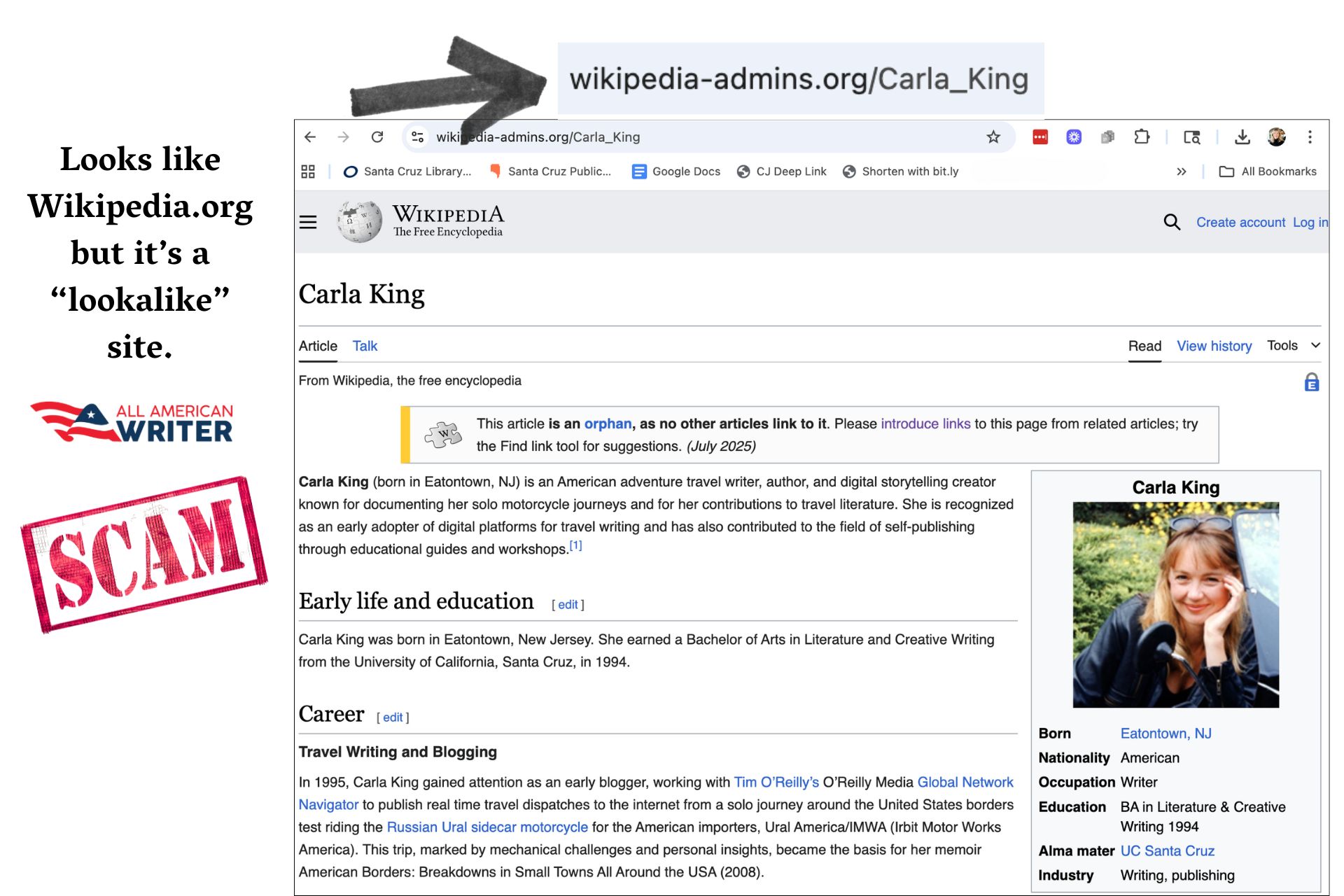
"Of course, I thought, and immediately asked for a refund. And I'm still asking for a refund. They replied for a while, promising I would get a call from someone higher up in the company. Who would tell me what? I wonder. I am still waiting for that call. And just for grins, I occasionally email Owen to ask him about it.
So... let's take a look at this scam. They are really getting so good now.
The Anatomy of the Scam
Here's how this kind of operation works:
• They use lookalike domains to host fake "draft" pages that resemble Wikipedia
• They claim a delay or process involving indexing or verification that makes it sound like Wikipedia has a back office
• They string you along just long enough to keep you from disputing the charge with your credit card company
• They upsell relentlessly, capitalizing on your investment of time and pride
Since then, I've discovered that a legitimate Wikipedia editor would never promise publication. Wikipedia pages are created by volunteer editors and reviewed by the community. No one has backdoor access. No one can promise it will stick.
Why It's So Hard to Get a Wikipedia Page
It's frustrating to see authors with fewer credentials than me on Wikipedia. I've authored books, contributed to the success of Ural motorcycles as a test rider, was a solo-female motorcycle travel pioneer, and contributed to early internet history with work on a high-visibility product— Peter Norton's PC Guru—one of the first multimedia software products. I was also a pioneering travel blogger in the mid-1990s. My work has appeared in anthologies like Best American Travel Writing and in respected niche publications.
So why is it still difficult?
Because Wikipedia has tightened its notability standards significantly over the past decade. A subject must be covered in independent, secondary sources that are considered reliable by Wikipedia's editorial community. Notability isn't based on accomplishments alone—it's based on coverage. You could be historically significant and still get rejected if no or few third-party sources have written about you in detail.
Meanwhile, authors with less coverage who do appear on Wikipedia may have slipped through in earlier, more lenient years—or had a PR machine place enough semi-legitimate coverage to satisfy gatekeepers. It's a flawed but evolving system, and one that does not reward quiet, under-the-radar careers, no matter how groundbreaking.
And here's something many authors don't realize: You're not allowed to create your own Wikipedia page. That's considered a conflict of interest. You also can't ask a close colleague, friend, or relative to create it for you—same problem. Even if you disclose your connection, Wikipedia editors will almost certainly reject or delete the submission.
So How Do You Find Legitimate Editors?
It's not easy—but it's not impossible. Here's what I discovered:
• Ask around in reputable online writing communities. Some contain experienced Wikipedia editors who may offer help if you truly meet the notability threshold.
• Engage with WikiProjects related to your field (e.g., WikiProject Women Writers, WikiProject Biography).
• Look through talk pages or editor profiles on similar articles to find editors who have contributed to your topic area.
• Use the Teahouse, a friendly help forum where new users can get guidance from experienced Wikipedians.
Keep in mind, ethical editors won't accept payment—they're volunteers. If you must hire someone, make sure it's a transparent consultant who abides by Wikipedia's conflict-of-interest rules. These professionals will:
• Disclose their involvement in your article on the Talk page (as required)
• Avoid using promotional language or unverifiable claims
• Only cite truly independent, third-party sources
• Have a visible history of Wikipedia contributions under a verified username
• Submit content through the proper channels like Articles for Creation
Again, avoid any consultant who promises guaranteed publication, has no verifiable Wikipedia editing history, or who tries to work around the rules rather than within them.
What About LocalWiki?
You may come across LocalWiki.org, a legitimate platform that invites communities to document local knowledge, history, and culture. While LocalWiki looks and feels a bit like Wikipedia, it serves a very different purpose. It's not part of the Wikipedia Foundation, and it doesn't carry the same weight in terms of notability or search engine authority.
LocalWiki is a valuable resource for regional storytelling and niche expertise, but a page on LocalWiki will not get you recognized on Wikipedia, nor will it contribute to your eligibility for inclusion there. That said, LocalWiki may be useful if you're writing about local events, people, or history that lacks broader media coverage. Just don't confuse its legitimacy for a pathway to Wikipedia.
Other Wikipedia Scams to Watch For
In addition to All American Writers, here are some other shady or outright scammy outfits that have been reported by authors:
• GetOnWikipedia.com – Often promises guaranteed placement and delivers lookalike drafts. Known for disappearing after a few months.
• Wikimoderator.org – Another scam domain mimicking Wikipedia. Pages published there are not real Wikipedia pages.
• Wikipagecreators.net – Offers fake notability reports and overpriced upsells for content placement in junk publications.
These companies often change names or launch new websites as older ones get flagged, so always vet carefully.
How to Get Legitimate Help
If you think you're notable enough for a Wikipedia page, here's how to go about it the right way:
- Start with the Articles for Creation process. This is how real Wikipedia articles are created when submitted by outsiders.
- Hire an experienced, ethical Wikipedia editor. Look for someone with a verifiable user history on Wikipedia, not a third-party agency with a vague promise.
- Focus on coverage, not credentials. If you lack third-party articles, focus on getting reviewed or profiled in reputable outlets.
- If you qualify, use resources like WikiProject Women Writers or AfroCROWD—many of these projects are dedicated to closing representation gaps and will help with ethical article creation.
The Takeaway
I didn't lose thousands of dollars. But I lost time. I gave space in my brain—and inbox—to a scam. And I'm telling this story because if it happened to me, a publishing professional who teaches other people how to avoid scams, it can happen to anyone.
Let this be your warning: If it's not published on Wikipedia.org, it's not a Wikipedia article. If someone guarantees a Wikipedia page, they're not legit. And if it starts to smell like a scam—it probably is.
